In a study that pushes the limits of observations currently possible from Earth, a team of NASA and European scientists recorded the "fingerprints" of mystery molecules in two distant galaxies, Andromeda and the Triangulum. Astronomers can count on one hand the number of galaxies examined so far for such fingerprints, which are thought to belong to large organic molecules, says the team's leader, Martin Cordiner of the Goddard Center for Astrobiology at NASA's Goddard Space Flight Center in Greenbelt, Md.
Figuring out exactly which molecules are leaving these clues, known as "diffuse interstellar bands" (DIBs), is a puzzle that initially seemed straightforward but has gone unsolved for nearly a hundred years. The answer is expected to help explain how stars, planets and life form, so settling the matter is as important to astronomers who specialize in chemistry and biology as determining the nature of dark matter is to the specialists in physics.
Cordiner is presenting the team's research at the American Astronomical Society meeting in Seattle, Wash., on Jan. 10, 2011, and the results from Andromeda were published in an Astrophysical Journal paper on Jan. 1. The findings provide some evidence against one of the top candidates on the list of suspects: polycyclic aromatic hydrocarbons (PAHs), a group of molecules that is widespread in space. The research also reveals that some of the signatures found in Andromeda and the Triangulum are similar to ones seen in our own Milky Way, despite some big differences between those galaxies and ours.
"We have studied DIBs in incredibly diverse environments. Some have low levels of UV radiation. Some have radiation levels thousands of times higher. Some have different amounts of 'ingredients' available for making stars and planets," Cordiner says. "And throughout all of these, we see DIBs."
Missing in action
Until now, only two galaxies beyond our own have been investigated in detail for DIBs. Those are our nearest neighbors, the Large and Small Magellanic Clouds, which lie 160,000 to 200,000 light years away. (Researchers have conducted selective studies elsewhere, however.)
Andromeda and the Triangulum are located much farther away, at about 2.5 to 3 million light years from Earth. "At those distances, individual stars are so faint that we need to push even the largest telescopes in the world to their limits in order to observe them," Cordiner says.
That statement might seem strange to anyone who has looked into the night sky and seen either of these galaxies with the naked eye. Under favorable conditions, the galaxies appear as smudges in the constellations that bear their respective names.
But to study DIBs, researchers need to do much more than see that the galaxy is there. They have to pick out individual stars within the galaxy, and only a few telescopes worldwide are powerful enough to gather sufficient light for that. (The team used the Gemini Observatory's telescope in Hawaii.) This is why most DIBs found so far have been in the Milky Way.
Whichever galaxy an astronomer chooses, though, it will be made up of tens to hundreds of billions of stars. "The first step is choosing which stars to observe," Cordiner explains.
Cordiner's colleagues at Queen's University in Belfast, U.K., took the lead on finding good targets. They picked blue supergiants -- stars that are very large, very hot and very bright. Supergiants also burn very clean: unlike our sun and other cooler stars, they contribute little background clutter to the observations being made.
To look for DIBs, an astronomer points the telescope at a star and scans through a rainbow made up of thousands of wavelengths of light. This rainbow, or spectrum, is extended a bit beyond visible light, into the UV at the blue end and into the infrared at the red end.
DIBs are not defined by what astronomers see while doing this, but by what they don't see. The colors missing from the rainbow, marked by black stripes, are the ones of interest. Each one is a wavelength being absorbed by some kind of atom or molecule.
A DIB is one of these regions where the color is missing. But compared to the nice, neat "absorption lines" that are identified with atoms or simple molecules, a DIB is not well-behaved, which is why it stands out.
"Astronomers were used to seeing quite sharp, narrow bands where typical atoms and molecules absorb," says Cordiner. "But DIBs are broad; that's why they are called 'diffuse.' Some DIBs have simple shapes and are quite smooth, but others have bumps and wiggles and may even be lopsided."
The mystery deepens
Over time, astronomers have been building up catalogs to show exactly which wavelengths are absorbed by all kinds of atoms and molecules. Each molecule has its own unique pattern, which can be used like a fingerprint: if a pattern found during an astronomical observation matches a pattern in one of the catalogs, the molecule can be identified.
It's a pretty straightforward concept. So, early researchers "would surely not have thought that the solution to the diffuse band problem would still be so elusive," wrote Peter Sarre in a 2006 review article about DIBs. Sarre, a professor of chemistry and molecular astrophysics at the University of Nottingham, U.K., supervised Cordiner's graduate-school work on DIBs.
The significance of the first DIBs, recorded in 1922 in Mary Lea Heger's Ph.D. thesis, was not immediately recognized. But once astronomers began systematic studies, starting with a 1934 paper by P. W. Merrill, they had every reason to believe the problem could be solved within a decade or two.
No such luck
More than 400 DIBs have been documented since then. But not one has been identified with enough certainty for astronomers to consider its case closed.
"With this many diffuse bands, you'd think we astronomers would have enough clues to solve this problem," muses Joseph Nuth, a senior scientist with the Goddard Center for Astrobiology who was not involved in this work. "Instead, it's getting more mysterious as more data is gathered."
Detailed analyses of the bumps and wiggles of the DIBs, suggest that the molecules which give rise to DIBs -- called "carriers" -- are probably large.
But like beauty, "large" is in the eye of the beholder. In this case, it means the molecule has at least 20 atoms or more. This is quite small compared to, say, a protein but huge compared to a molecule of carbon monoxide, a very common molecule in space.
Recently, though, more interest has been focused on at least one small molecule, a chain made from three carbon atoms and two hydrogen atoms (C3H2). This was tentatively identified with a pattern of DIBs.
Tenacious D
On the list of DIB-related suspects, all molecules have one thing in common: they are organic, which means they are built largely from carbon.
Carbon is great for building large numbers of molecules because it is available almost everywhere. In space, only hydrogen, helium and oxygen are more plentiful. Here on Earth, we find carbon in the planet's crust, the oceans, the atmosphere and all forms of life.
Likewise, astronomers "see DIBs pretty much in any direction we look," says Jan Cami, an astronomer at the University of Western Ontario, Canada. He has collaborated with Cordiner before but was not involved in this study. "And we see lots of DIBs."
Carbon is also great for building molecules in all kinds of configurations -- millions of carbon compounds have been identified -- and especially for building very stable molecules.
DIB carriers also seem to be quite stable. They survive the harsh physical conditions in the interstellar medium -- the material found in the space between the stars. They also hang tough in the Large Magellanic Cloud, where radiation levels are thousands of times stronger than in the Milky Way. In fact, says Cordiner, DIB carriers seem comfortable almost everywhere except in the clouds of dense gas where stars are born.
"The carriers are readily formed but not readily destroyed in a wide range of different environments," says Cordiner. "It's remarkable how tenacious these molecules really are."
In short, carriers are thought to be made of carbon, Cami says, "because it's a lot easier to build strong and stable molecules from carbon atoms than from other elements, such as silicon or sulfur. Using those elements rather than carbon would be like building a house from a bucket of sand while there's a huge pile of bricks at the construction site."
The top three carrier candidates are: chain-like molecules, like the one now tentatively associated with a pattern of DIBs; PAHs, which often come up in studies of how planets formed; and compounds related to fullerenes, the soccer-ball-shaped molecules also known as buckyballs.
"This list covers most types of carbon molecules," notes Cami. "Chains are essentially the one-dimensional carbon molecules, PAHs are the two-dimensional ones, and fullerene compounds are the three-dimensional ones."
Present and accounted for
In spite of the challenges of looking for DIBs in other galaxies, it's worth the effort to astronomers because they need to see what DIBs look like under different conditions.
Granted, conditions are not uniform everywhere within a galaxy. Some stars have planets near them; others don't. Between the stars, in the vast tracts of interstellar medium, the relative amounts of gas and dust floating around can be different from one region to the next. And the exact mixture of chemicals can vary a little from place to place.
"But being on Earth and looking at another object in the Milky Way is like being in the crowd at Times Square in New York City on New Year's Eve and trying to find your friend," explains Nuth. "It's much easier to spot the person if you are on a balcony rather than standing in the crowd yourself." Likewise, it's much easier to get a clear overview of a galaxy when you are outside of it.
In some respects, Andromeda and the Triangulum are similar to the Milky Way. All three are spiral galaxies that belong to a collection of more than 30 nearby galaxies called the Local Group. The Milky Way is the largest member of this group. Andromeda is the second-largest, and the Triangulum is third.
Like the Milky Way, Andromeda and the Triangulum are thought to be good places to synthesize large organic molecules, which is what DIBs carriers are thought to be. And yet, says Cordiner, "nobody knew until now whether DIBs actually existed in either galaxy."
The team found that, indeed, DIBs do exist in both places, and they are strong, which implies there are many carriers.
In the Milky Way, when researchers find strong DIBs, they tend to find a lot of dust, too. This makes sense, because whenever there's more raw material available to make DIBs carriers, there's also more available to make dust. The team found the same situation in Andromeda, Cordiner says.
Of greater interest in Andromeda was whether the strength of the DIBs was related to the amount of PAHs, which are high on the list of candidates for carriers. The researchers knew going into the study that PAHs are plentiful in Andromeda, as they are in the Milky Way.
"The details of the PAH population seem to be somewhat different in Andromeda, though," says Cami. "This makes it interesting to try and find out exactly what is different."
But after checking to see if the PAH levels were related to DIBs strength, "we didn't find any correlation between the two," Cordiner says. That finding doesn't rule out a connection, but it might shift more attention to chains of carbon atoms or to fullerene compounds.
The carriers are not pure, isolated fullerenes, says Cami, who led the team that first detected fullerenes in space. More likely, "atoms or molecules are either locked up in fullerene cages or attached to the outside surface, " he explains. "This might even hold for some of the other proposed molecules. For example, you could think of carbon chains dangling from other molecules or even from dust grains."
The more things change . . .
One big difference between the Milky Way and Andromeda is the number of massive young stars. The Milky Way has more than Andromeda. Because those young stars generate a lot of UV radiation, the Milky Way's interstellar medium has higher levels of this radiation than Andromeda's does.
More radiation means a harsher environment, so organic molecules should survive better in an environment with less radiation. In that sense, Andromeda should be more favorable for the carriers of DIBs and, in theory, should be able to boast more of them. But Cordiner and his colleagues found that the DIBs in Andromeda were only slightly stronger than those in the Milky Way, implying that Andromeda can only claim slightly more carriers.
The observations in the Triangulum add even more intrigue. There, the researchers found strong DIBs even though this galaxy differs in its metallicity, which is a measure of the availability of ingredients for making stars and planets.
The consistency from galaxy to galaxy is surprising, given how much the conditions are thought to vary among them. "But there are no detailed studies of Andromeda to tell us everything we want to know about conditions there," says Cordiner. "And even less is known about the Triangulum."
As is usually the case in cutting-edge astronomy, some assumptions had to be made, and a lot depends on how well those assumptions hold up as more information becomes available.
Meanwhile, researchers will try to learn everything they can about DIBs near and far and the organic molecules they represent. "If we're going to understand fully how interstellar chemistry works -- how stars and planets form," says Cordiner, "then we need a full understanding of the ingredients they use."
Traduzione a cura di Arthur McPaul
Le molecole della vita sospese nelle galassie
In uno studio che spinge i limiti di osservazioni possibili dalla Terra al massimo, una squadra della NASA e gli scienziati europei hanno registrato le "impronte digitali" di misteriose molecole in due galassie lontane, Andromeda e Triangolo. Gli astronomi possono contare su una mano il numero di galassie finora esaminate con la presenza di tali impronte. Si ritiene che appartengano a grandi molecole organiche, dice il team leader, Martin Cordiner del Centro Goddard per l'astrobiologia della NASA's Goddard Space Flight Center in Greenbelt, Md.
Capire esattamente quali sono le molecole che hanno lasciato questi indizi, note come "bande interstellari diffuse" (DIB), è un mistero che inizialmente sembrava semplice, ma è rimasto irrisolto per quasi cento anni. La risposta è attesa per aiutare a spiegare come si formano le stelle, i pianeti, la chimica delle forme di vita chimica e biologia.
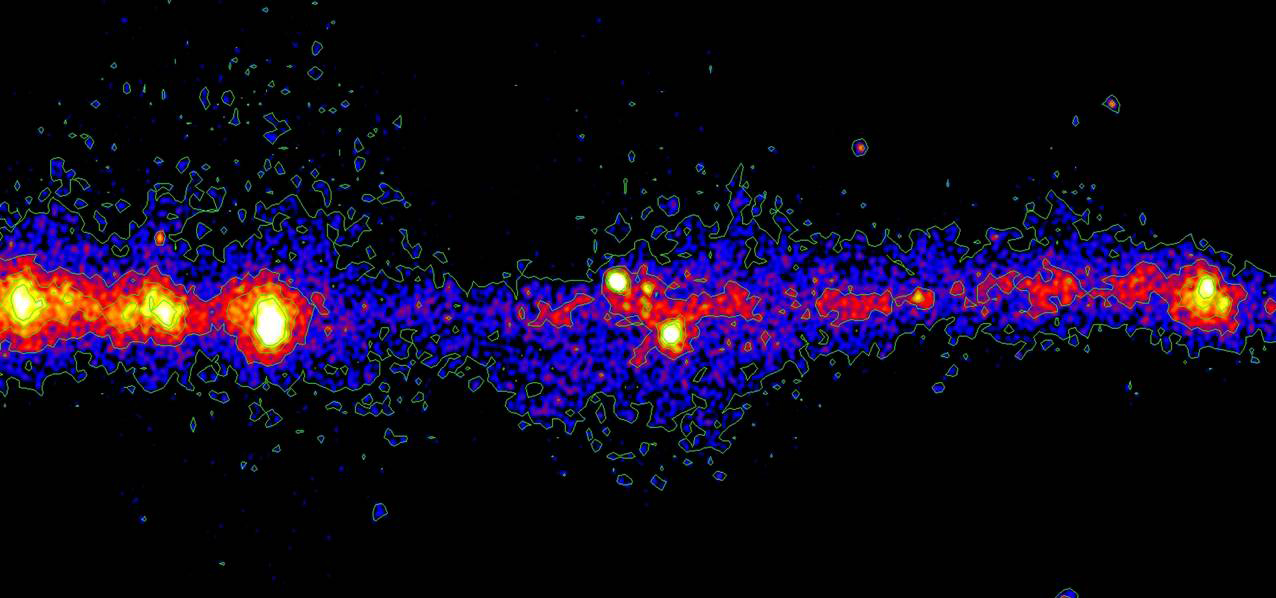
Foto in alto: Andromeda, è una delle due galassie lontane dove gli astronomi recentemente hanno scoperto le bande interstellari diffuse (DIB). I cerchi indicano una forte DIB. Una "x" significa che non sono stati osservate le DIB. I colori nei riquadri corrispondono alle lunghezze d'onda dello spettro: blu per le UV, verde per la luce visibile, e rosso per infrarossi. (Credit: image M31 da Bill Schoening, Vanessa Harvey / programma REU / NOAO / AURA / NSF Insets da Nick Cox, Istituto di Astronomia, KU Leuven).
Un team di ricerca guidato dal prof. Cordiner al convegno dell'American Astronomical Society a Seattle, nello stato di Washington, il 10 gennaio 2011, ha pubblicato i risultati sulla galassia Andromeda sull'Astrophysical Journal del 1 gennaio. I risultati forniscono alcuni elementi che provano la presenza di uno dei candidati in cima alla lista dei sospetti: gli idrocarburi policiclici aromatici (IPA), un gruppo di molecole molto diffuse nello spazio. La ricerca rivela inoltre che alcune delle tracce si trovano in Andromeda e nel Triangolo sono simili a quelli visti nella nostra Via Lattea, nonostante alcune differenze tra queste galassie e la nostra.
"Abbiamo studiato le DIB in ambienti incredibilmente diversi. Alcuni hanno bassi livelli di radiazioni UV. Alcuni hanno livelli di radiazioni migliaia di volte superiori. Alcuni hanno diverse quantità di 'ingredienti' a disposizione per dar vita alle stelle e i pianeti", ci dice Cordiner . "E durante tutto questo, che vediamo le DIB".
Fino ad ora, solo due galassie oltre la nostra sono stata studiata in dettaglio per la rilevazione delle DIB, cioè i nostri vicini più prossimi, la Grande e Piccola Nube di Magellano, che si trovano a 160.000 e a 200.000 anni luce di distanza. (I ricercatori hanno condotto studi selettivi anche altrove, però).
Andromeda e il Triangolo si trovano molto più lontano, a circa 2,5-3.000.000 anni luce dalla Terra. "A quelle distanze, le singole stelle sono così deboli che abbiamo bisogno di spingere anche i più grandi telescopi al mondo per i loro limiti, al fine di osservare loro," dice Cordiner.
Tale affermazione potrebbe sembrare strana per chi ha guardato il cielo notturno e ha visto una di queste galassie ad occhio nudo. In condizioni favorevoli, le galassie appaiono come macchie diffise nelle costellazioni che portano i loro rispettivi nomi.
Ma per studiare le DIB, i ricercatori devono fare molto di più vedere che la galassia. Devono individuare le singole stelle all'interno di essa e solo un paio di telescopi in tutto il mondo sono abbastanza potenti per raccogliere la luce sufficiente per questo obiettivo. (Il team ha utilizzato il telescopio dell'Osservatorio Gemini alle Hawaii.) Questo è il motivo che spiega perche le DIB sono state trovate finora solo nella Via Lattea.
Qualunque sia la galassia che un astronomo sceglie, sarà costituita da decine a centinaia di miliardi di stelle. "Il primo passo è la scelta che per osservare le singole stelle," spiega Cordiner.
Cordiner i colleghi alla Queen's University di Belfast, Regno Unito, hanno scelto di cercare le supergiganti blu, stelle che sono molto grandi, molto calde e molto luminose. Le supergiganti bruciano in molto pulito: a differenza del nostro Sole e di altre stelle più fredde, esse contribuiscono poco a fare confusione sullo sfondo.
Per cercare le DIB, un astronomo punta il telescopio su una stella e scansiona un arcobaleno composto da migliaia di lunghezze d'onda della luce. Questo arcobaleno, o spettro, si estende un po 'oltre la luce visibile, negli UV fino al blu e nell'infrarosso fino al rosso.
I DIB non sono definiti da questa analisi, ma da ciò che non si vede. I colori che mancano nell'arcobaleno, segnati da strisce nere, sono quelle di interesse. Ciascuno posssiede una lunghezza d'onda che viene assorbita da qualche tipo di atomo o molecola.
Un DIB è una di queste regioni in cui il colore è mancante. Ma rispetto alle"righe di assorbimento" pulite, che sono identificate con atomi o molecole semplici, un DIB non è ben caratteriszzato, ed è per questo che si distingue.
"Gli astronomi sono stati abituati a vedere bande strette dove gli atomi e le molecole tipiche vengono assorbite", dice Cordiner. "Ma le DIB sono larghe, per questo si definisono 'diffuse'. Alcune DIB hanno forme semplici e sono abbastanza liscie, ma altre hanno increspature e possono anche essere sbilenche".
Il mistero si infittisce
Nel corso del tempo, gli astronomi hanno costruito cataloghi per mostrare esattamente quali sono le lunghezze d'onda di assorbimento di tutti i tipi di atomi e molecole. Ogni molecola ha una sua configurazione unica, che può essere utilizzata come un'impronta digitale: se un modello trovato nel corso di una osservazione astronomica corrisponde a un modello in uno dei cataloghi, la molecola può essere dunque identificata.
E' un concetto abbastanza semplice. "Così, i ricercatori all'inizio non avrebbero mai pensato che la soluzione al problema della banda diffusa sarebbe stato ancora così sfuggente", ha scritto Peter Sarre in un articolo del 2006 sulle DIB. Sarre, un professore di chimica molecolare e astrofisica presso l'Università di Nottingham, Regno Unito, ha visionato lo studio di Cordiner sulla DIB.
Il significato del primo DIB, registrato nel 1922, nella tesi di dottorato di ricerca di Maria Lea Heger, non fu immediatamente riconosciuto. Ma una volta che gli astronomi iniziarono studi sistematici, partendo da una carta del 1934 di PW Merrill, avevano tutte le ragioni per credere che il problema poteva essere risolto entro un decennio o al massimo due.
Niente da fare
Da allora sono stati documentati oltre 400 DIB ma nessuno è stato individuato con sufficiente certezza per gli astronomi a considerare il suo caso chiuso.
"Con queste numerose bande diffuse, si potrebbe pensare che gli astronomi hanno abbastanza indizi per risolvere il problema", riflette Giuseppe Nuth, scienziato senior presso il Centro Goddard per l'astrobiologia, che non è stato coinvolto in questo lavoro. "Invece, è sempre più misterioso quanto più i dati vengono raccolti."
Analisi dettagliate delle variazioni del DIB, suggeriscono che le molecole che danno luogo al DIB, dette "portatori", sono probabilmente di grandi dimensioni e hanno almeno 20 o più atomi. Questo è abbastanza ridotto rispetto ad una proteina ma enorme rispetto ad una molecola di monossido di carbonio, una molecola molto comune nello spazio.
Recentemente, però, più interesse è stato focalizzato in almeno un piccola molecola, una catena fatta da tre atomi di carbonio e due atomi di idrogeno (C3H2). Questo è stato provvisoriamente identificato con un modello di DIB.
Sulla lista dei sospetti DIB, tutte le molecole hanno una cosa in comune: sono organiche, il che significa che sono costruite in gran parte dal carbonio.
Il carbonio è idoneo per la costruzione di un gran numero di molecole, in quanto è disponibile quasi ovunque. Nello spazio, soltanto l'idrogeno, l'elio e l'ossigeno sono più abbondanti. Qui sulla Terra, troviamo carbonio nella crosta del pianeta, gli oceani, l'atmosfera e tutte le forme di vita.
Allo stesso modo, gli astronomi "vedono le DIB praticamente in qualsiasi direzione guardiamo", afferma Jan Cami, astronomo presso l'Università del Western Ontario, Canada. Ha collaborato con Cordiner ma non è stato coinvolto in questo studio. "E vediamo un sacco di DIB".
Il carbonio è fondamentale anche per la costruzione di molecole in tutti i tipi di configurazioni, milioni di composti del carbonio sono stati identificati in particolare per la costruzione di molecole molto stabili.
I vettori DIB sembrano essere abbastanza stabili. Sopravvivono alle dure condizioni fisiche del mezzo interstellare, il materiale che si trova nello spazio tra le stelle. Essi hanno inoltre resistito nella Grande Nube di Magellano, dove i livelli di radiazione sono migliaia di volte più forti che nella Via Lattea. In realtà, dice Cordiner, i vettori dei DIB sembrano trovare origine quasi ovunque, tranne che nelle nuvole di gas denso in cui nascono le stelle.
"I vettori sono prontamente formati ma non facilmente distrutti in una vasta gamma di ambienti diversi", spiega Cordiner. "E notevole vedere come tenaci siano queste molecole".
In breve, i vettori si pensa che siano fatti di carbonio, dice Cami: "Sono molto più facili da costruire come molecole forti e stabili col carbonio piuttosto che da altri elementi, come il silicio o lo zolfo. L'utilizzo di tali elementi, piuttosto che del carbonio sarebbero come la costruzione di una casa da un secchio di sabbia, mentre c'è un enorme cumulo di mattoni in cantiere".
I primi tre candidati del vettore sono: molecole a catena come quelle ora provvisoriamente associate ad un quadro del DIB, le IPA, che si registrano spesso negli studi della formazione planetaria in cui si sono formati e composti i fullereni, le molecole di calcio a forma di palla.
"Questo elenco comprende molti tipi di molecole di carbonio", osserva Cami. "Le catene sono essenzialmente le molecole di carbonio a una dimensione, gli IPA sono quelle a due dimensioni, e i composti fullerene sono quelle a tre dimensioni".
Presente e contabilizzate
Nonostante la ricerca di DIB in altre galassie sia estenuante e difficile, vale la pena continuare perchè gli astronomi hanno bisogno di vedere cosa le DIB hanno in comune in condizioni diverse.
Certo, le condizioni non sono uniformi all'interno di una galassia. Alcune stelle hanno pianeti vicino a loro, altre no. Tra le stelle, in vasti tratti di mezzo interstellare, le quantità relative di gas e polveri che fluttuano attorno possono essere diverse da una regione all'altra e la miscela di sostanze chimiche può variare da luogo a luogo.
Il team ha scoperto che, effettivamente, le DIB esistono in entrambi i luoghi, e ciò implica che ci sono molti vettori.
Nella Via Lattea, quando i ricercatori a hanno trovato dei DIB forti, hanno trovato anche un sacco di polvere. Questo ha senso, perché ogni volta che c'è più materiale grezzo a disposizione per fare vettori DIB, c'è anche più disponibili a fare la polvere. La squadra ha trovato la stessa situazione in Andromeda, Cordiner dice.
Di maggiore interesse per Andromeda è capire se la forza del DIB è legato alla quantità di IPA, che è in alto nella lista dei candidati per i vettori. I ricercatori sapevano che le IPA sono abbondanti in Andromeda, come lo sono nella Via Lattea.
"I dettagli della popolazione PAH sembrano essere un po diversi in Andromeda, però," dice Cami. "Questo la rende interessante per cercare di scoprire esattamente che cosa sia diverso".
"Ma dopo il controllo per vedere se i livelli di IPA sono stati correlati alle DIB, non abbiamo trovato alcuna correlazione tra i due" Cordiner dice. Tale constatazione non esclude una connessione, ma potrebbe spostare più attenzione alle catene di atomi di carbonio o di composti di fullerene.
I vettori non sono puri, fullereni isolati, dice Cami, che ha guidato la squadra che per prima individuazione di essi nello spazio. Più probabilmente, "sono atomi o molecole rinchiusi in gabbie di fullerene o che ricoprono la superficie esterna", spiega. "Potrebebro anche contenere delle altre molecole, come ad esempio, alcune catene di carbonio o addirittura da grani di polvere".
Le cose cambiano più. . .
Una grande differenza tra la Via Lattea e Andromeda è il numero di giovani stelle massicce. La Via Lattea ne ha più di Andromeda. Poiché quelle giovani generano un sacco di radiazioni UV, il mezzo interstellare della Via Lattea ha livelli più elevati di questa radiazione.
Più di radiazione si intende un ambiente più pesante, molecole in modo organico dovrebbero sopravvivere meglio in un ambiente con meno radiazioni. In questo senso, Andromeda dovrebbe essere più favorevole per i portatori di DIB e, in teoria, dovrebbe essere in grado di averne di più. Ma Cordiner e i suoi colleghi hanno trovato che i DIB in Andromeda sono solo leggermente più forti di quelli della Via Lattea.
Le osservazioni nel Triangolo aggiugono ancora più mistero alla questione.
I ricercatori hanno infatti trovato un forte DIB, anche se questa galassia si differenzia nella sua metallicità, che è una misura della disponibilità di ingredienti per fare stelle e pianeti.
La consistenza da galassia a galassia è sorprendente, visto quanto le condizioni sono pensati per variare tra di loro. "Ma non ci sono studi dettagliati di Andromeda per dirci tutto quello che volete sapere sulle sue condizioni e poco si sa anche del Triangolo" dice Cordiner.
Nel frattempo, i ricercatori cercheranno di imparare tutto quanto è possibile sulle DIB vicine e lontane e le molecole organiche che rappresentano. "Per comprendere appieno come funziona la chimica interstellare e la formazione stellare e planetaria, avremmo bisogno di una piena comprensione degli ingredienti che essi usano", spiega Cordiner,